Alientrap’s giant crab adventure delivers incredible atmosphere but stumbles on combat, performance, and solo accessibility
DuneCrawl represents a particular category of disappointment reserved for games possessing extraordinary creative vision undermined by fundamental execution problems. The premise—piloting massive crab fortresses across endless desert landscapes while battling ceramic enemies and scavenging ruins—sounds like instant cult classic material. Fifteen hours later, both solo and cooperative, that promise dissolves into sand.
Alientrap crafted something visually remarkable. The aesthetic ambition deserves genuine admiration. But video games require functional gameplay beneath their beautiful surfaces, and DuneCrawl’s foundation crumbles under scrutiny.
 StarRupture Early Access Review: A Beautiful, Broken Factory Builder
 Table of Contents
Visual and Audio Design Excel Beyond Expectations
Credit where earned: DuneCrawl looks absolutely stunning.
Unreal Engine 5 Delivers Spectacular Results
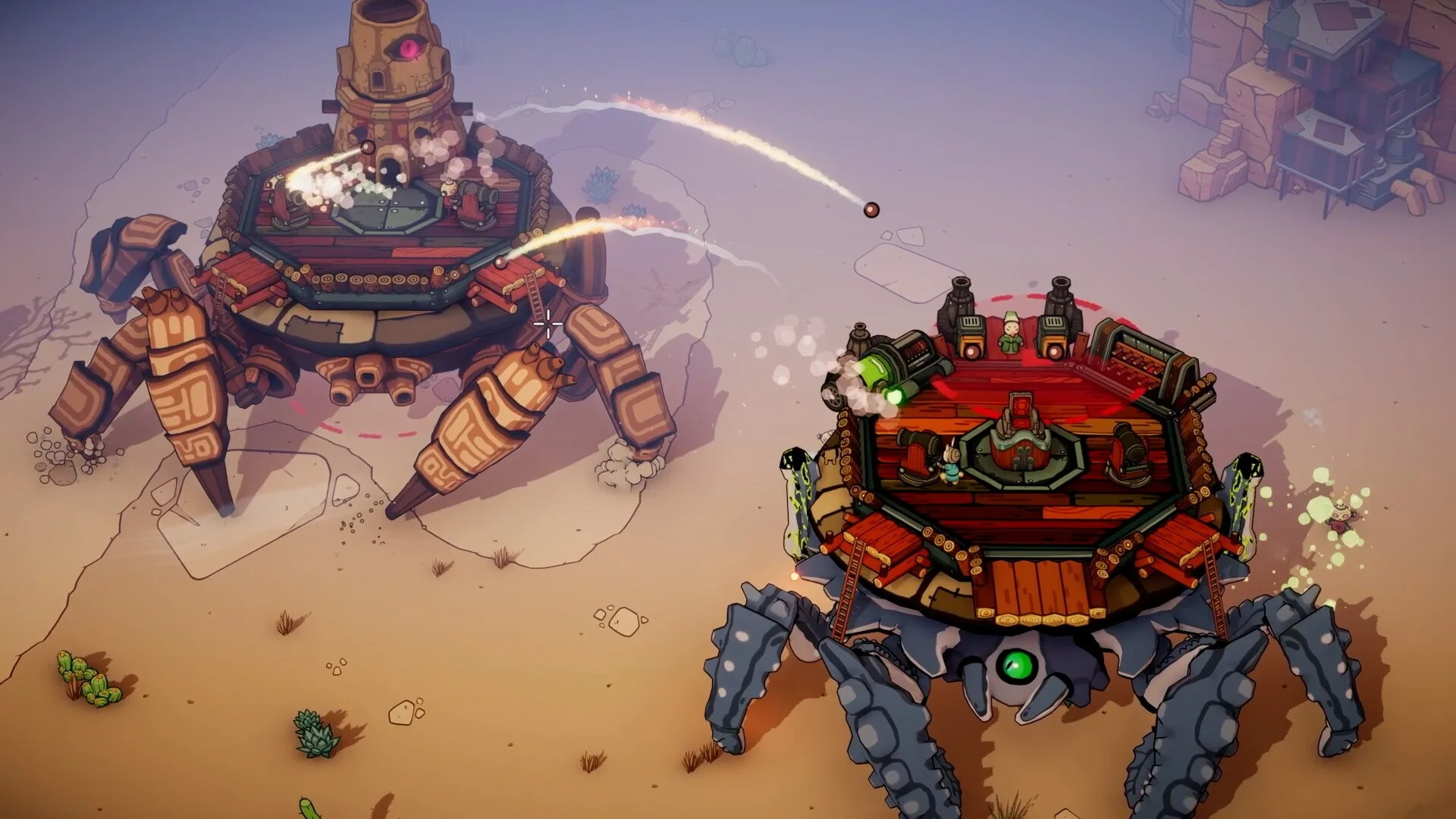
The development team maximized Unreal Engine 5 capabilities to create genuinely striking desert environments. Vibrant color palettes contrast against harsh sandy expanses. Lighting shifts create atmospheric moments that screenshot beautifully. Character designs embrace distinctive indie sensibilities that distinguish the game from generic fantasy aesthetics.
The crab walkers themselves impress through sheer scale. Watching these mechanical creatures traverse dunes delivers the spectacle the concept promised. Environmental art direction maintains consistency throughout, never feeling procedurally generated or visually repetitive despite the desert setting’s inherent limitations.
Soundtrack Deserves Standalone Recognition
Audio design matches visual ambition. The musical score blends western guitar influences with synthetic pulses and percussion that perfectly complement the strange world Alientrap constructed. Sound design reinforces the alien atmosphere without becoming intrusive.
Evaluated purely on presentation, DuneCrawl approaches excellence. Unfortunately, games require more than atmosphere.
 Cloudheim Review – Kicking Goblins for Profit
 Solo Play Barely Functions
Marketing materials indicate single-player compatibility. This proves technically accurate in the same way walking across a continent qualifies as transportation—possible but inadvisable.
AI Companions Provide Minimal Assistance
Solo players receive spirit companion support for crab management tasks. These AI helpers struggle with basic responsibilities. Repair priorities seem random. Combat contributions remain negligible. During intense encounters, the assistance provided falls catastrophically short of requirements.
The fundamental problem extends beyond AI competence. DuneCrawl’s systems assume multiple human operators coordinating tasks simultaneously. Single players must handle steering, weapons, repairs, and navigation alone while AI companions watch unhelpfully. The experience becomes overwhelming rather than challenging.
Gameplay Loop Exposes Core Emptiness
Without cooperative chaos masking structural weaknesses, solo sessions reveal how little substance exists beneath the presentation. Exploration leads to combat leads to looting leads to upgrades leads to more exploration. This cycle repeats without meaningful variation or escalating complexity.
The world’s visual beauty cannot compensate for experiential hollowness when experienced alone. Environmental storytelling remains sparse. Discovery moments lack impact. The loop burns out rapidly without social interaction providing external entertainment value.
 Captain Wayne – Vacation Desperation Review: The Best Boomer Shooter of the Year Costs 10€
 Combat Systems Disappoint Consistently
Whether controlling characters on foot or manning crab weaponry, combat feels disconnected and unsatisfying.
Ground Combat Lacks Precision
On-foot encounters suffer from floaty, imprecise mechanics. Controller aiming feels particularly unreliable. Melee attacks miss targets that appear within range. Ranged weapons lack impact feedback. Enemy hitboxes seem inconsistently defined—attacks that visually connect sometimes register while clear misses occasionally deal damage.
Dodging proves equally unreliable. Evasion timing feels detached from animation feedback. Attacks that should miss connect anyway. The disconnect between player input, visual feedback, and actual mechanical results creates persistent frustration rather than satisfying skill expression.
Crab Combat Becomes Tedious Labor
Cooperative crab battles represent the game’s flagship feature. One player steers while others manage weapons and systems. Conceptually, this promises exciting coordinated action resembling naval combat with walking vehicles.
Execution transforms this promise into mundane busywork. Manual cannonball loading, slow turret rotation, imprecise aiming, and repetitive firing sequences feel like chores rather than thrilling combat. Physics inconsistencies compound frustrations—players frequently get launched from positions by their own vehicle’s movements.
The swashbuckling fantasy Alientrap envisioned becomes monotonous routine within hours.
 Moonlighter 2 Early Access Review: The Best Shopkeeping Sim Just Got a Whole Lot Better
 Technical Performance Requires Significant Improvement
Testing on Steam Deck revealed severe performance limitations that extend beyond handheld hardware constraints.
Frame Rate Collapses During Core Gameplay
Small island exploration maintains acceptable performance. The moment gameplay shifts to crab traversal—the experience’s central attraction—frame rates crater. Drops reaching single digits transform the game into slideshow presentations rather than interactive experiences.
Open world navigation shouldn’t require high-end desktop hardware when smaller enclosed areas run adequately on portable devices. Optimization clearly needs substantial additional development time.
Bugs Interrupt Sessions Regularly
Performance problems exist alongside persistent bugs. Map geometry allows players to fall through terrain into voids. Environmental collision detection traps characters requiring forced respawns. Quest tracking fails to update after objective completion, leaving progression unclear.
These issues suggest a product released prematurely. Another six months of development and testing could address many problems currently plaguing the experience.
 Mafia: The Old Country Review: An Offer You Can’t Quite Refuse
 Final Assessment
DuneCrawl possesses ingredients for something special. Art direction establishes unique identity. Audio design creates memorable atmosphere. The core concept of desert-traversing crab fortresses offers genuine novelty.
Execution fails these foundations. Combat provides neither satisfaction nor depth. Solo accessibility barely exists despite marketing claims. Technical stability remains unacceptable for release-state software. Cooperative play can generate entertainment through social chaos, but the underlying systems never support that enjoyment mechanically.
Players with patient friend groups and powerful hardware might extract worthwhile experiences from coordinated sessions. Everyone else encounters a beautiful shell concealing disappointing emptiness.
Score: 5.5/10 — Remarkable presentation cannot compensate for fundamental gameplay and technical shortcomings.
Have you tried DuneCrawl? Share your crab adventures in the comments below.
 News Tower Review: It’s Like The Sims Meets Citizen Kane, and I’m Addicted